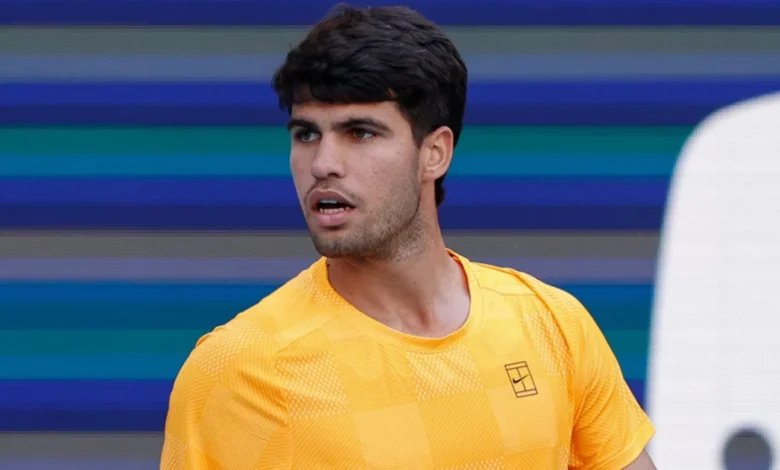
Less than 48 hours after a heart-wrenching defeat in the Monte-Carlo Masters final, Spanish tennis sensation Carlos Alcaraz navigated an early injury scare to secure his passage into the last 16 of the Barcelona Open. The young phenom, facing immense pressure to reclaim the world number one ranking from his fierce rival Jannik Sinner, battled through a wrist concern to overcome Finland’s Otto Virtanen with a commanding 6-4, 6-2 victory on his home soil.
The match, which lasted just 85 minutes, saw Alcaraz demonstrate remarkable resilience. Despite taking a medical timeout for his wrist at the conclusion of the first set, he exhibited no visible signs of physical distress throughout the remainder of his opening-round encounter. This victory is particularly significant as Alcaraz must win the Barcelona Open title to ascend back to the pinnacle of the ATP rankings, a testament to the high stakes of his current campaign.
A Return to Familiar Territory and a Familiar Drive
The return to Barcelona holds a special significance for Alcaraz. The Catalan capital has been a fortress for the young Spaniard, who has established a formidable record at this prestigious clay-court event. His victory over Virtanen marked his 15th win in his last 16 matches on the Barcelona courts, underscoring his dominance on this surface and at this specific tournament. This remarkable consistency on clay also extends to his broader record, with 27 wins in his last 29 matches played on the red dirt. The win against Virtanen also marked his 22nd victory of the 2026 season, a statistic that highlights his consistent performance across various tournaments.
"It feels great to be back and to get another win in front of my people in Barcelona, it means everything," Alcaraz expressed in his post-match press conference, his voice conveying the deep connection he feels with the city and its passionate tennis fans. "This morning was my first practice here to adapt to the conditions. Different conditions to Monte Carlo but overall I am really happy with the way that I played and solved the problems that I had in the first set. I ended up playing great tennis, so hopefully in the next round I will feel a little bit better."
Alcaraz’s immediate focus is on adapting to the specific conditions of the Barcelona tournament, which he acknowledged differ from those in Monte Carlo. His ability to swiftly adjust and overcome challenges, as demonstrated in the first set against Virtanen, is a hallmark of his maturing game. The prospect of playing better in subsequent rounds will be crucial as he progresses through a draw that, notably, does not feature his primary adversary, Jannik Sinner.
The Quest for the Top Spot: Motivation and Strategy
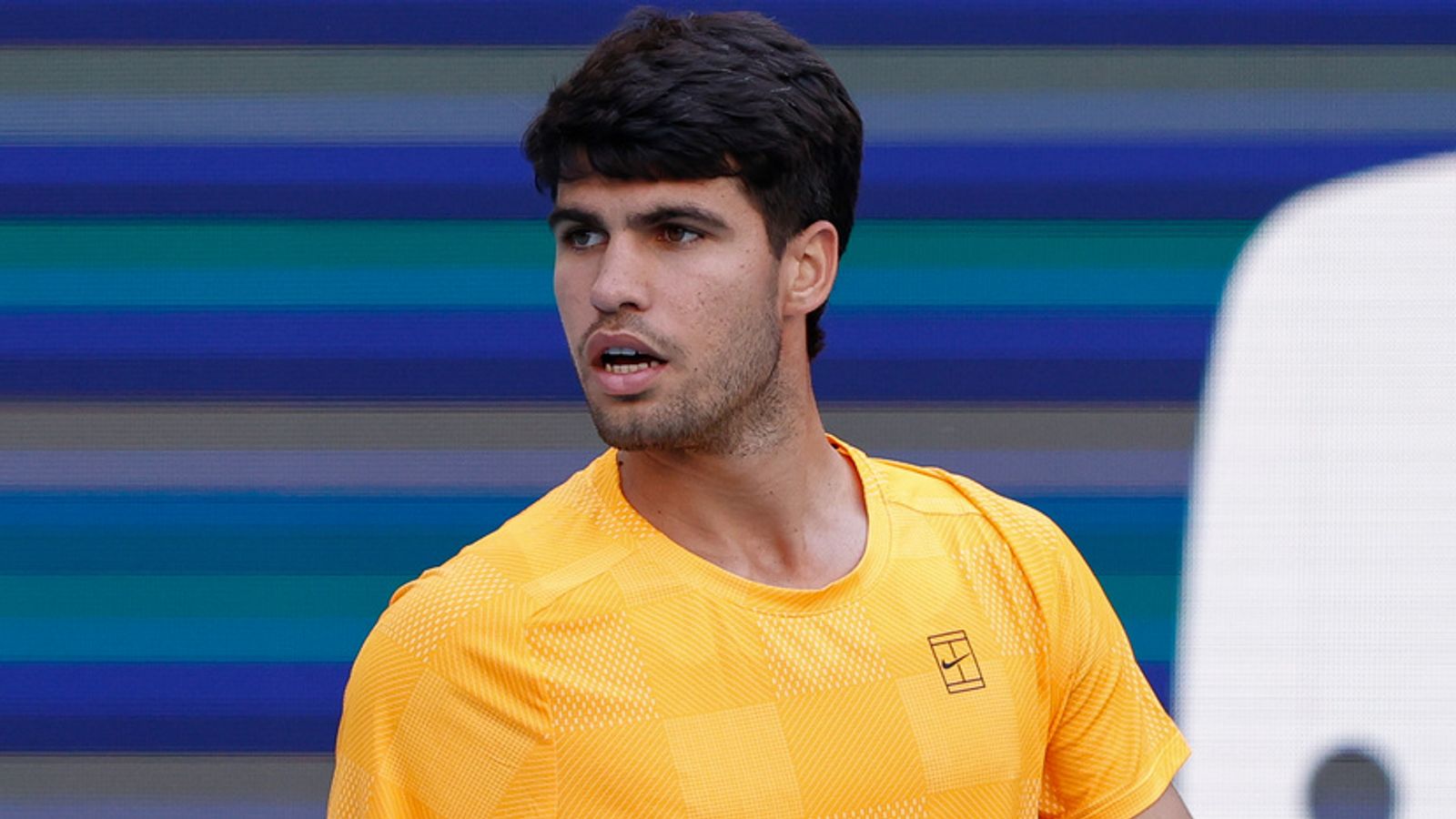
The fierce rivalry between Carlos Alcaraz and Jannik Sinner has become a defining narrative of the current men’s tennis landscape. Alcaraz’s loss in Monte Carlo, where he was the defending champion, saw him cede not only the title but also the coveted world number one ranking to the in-form Italian. This development has injected a potent dose of urgency into Alcaraz’s pursuit of further silverware.
"I saw that I have to win the tournament here if I want to get the number one ranking back," Alcaraz stated candidly. "The battle between Jannik and myself is great. It probably provides extra motivation. But we’re focused and my mind is set on trying to stay on the path we’re on, trying to keep improving. We’re clear about what we need to do in training and in matches. That’s the main goal, results and points are extra motivation."
This statement reveals a strategic depth to Alcaraz’s ambition. While the immediate reward of reclaiming the top ranking is a powerful motivator, his primary objective remains the continuous improvement of his game. This long-term perspective, coupled with the short-term pressure, creates a compelling dynamic for the remainder of the season. His team’s clear focus on training and match preparation suggests a meticulously planned approach to achieving his goals.
A Challenging Road Ahead: Sinner’s Absence and Alcaraz’s Ambitions
The absence of Jannik Sinner from the Barcelona Open draw presents Alcaraz with a significant opportunity. Sinner, who has been on a remarkable winning streak, securing consecutive titles in Indian Wells, Miami, and Monte Carlo, has opted for a period of rest. This decision, while understandable given his recent exertions, opens up a crucial window for Alcaraz to capitalize.
"I won’t miss him this week," Alcaraz joked during his pre-tournament press conference, a lighthearted remark that underscored the competitive spirit between the two young stars. This playful jab belies the intense on-court battles they have engaged in, pushing each other to new heights.
Alcaraz’s season has already been marked by significant achievements. He commenced the year by completing the career Grand Slam at the Australian Open, a monumental feat at such a young age. He also secured victory at the ATP 500 event in Doha, demonstrating his early-season form and ambition. The Barcelona Open represents his next opportunity to add another prestigious title to his burgeoning collection.
Looking Ahead: The Clay Court Season and Grand Slam Aspirations
The Barcelona Open is a pivotal tournament in Alcaraz’s broader clay-court campaign. His schedule is strategically designed to build momentum leading up to the French Open, where he is the defending champion. Following his campaign in Barcelona, Alcaraz is expected to compete in the Masters 1000 events in Madrid and Rome, both crucial stepping stones on the road to Roland Garros.
His commitment to a full clay-court schedule underscores his dedication to mastering this surface, a surface where consistency and endurance are paramount. The French Open, beginning on May 24th, represents a significant target, where he will aim to defend his title against a formidable field of competitors.
The ongoing evolution of the rivalry between Alcaraz and Sinner, and their respective performances on the European clay-court swing, will undoubtedly be a central narrative in the tennis world. Alcaraz’s ability to manage his physical well-being, particularly following the wrist concern, will be closely watched. His journey back to the world number one ranking is not just a personal quest but a storyline that captivates fans globally, promising further enthralling encounters and a compelling season ahead.
Historical Context of the Barcelona Open
The Barcelona Open Banc Sabadell, often referred to simply as the Barcelona Open, is one of the most prestigious clay-court tournaments on the ATP Tour. Established in 1953, it has a rich history and has been a happy hunting ground for many of the sport’s greatest players, particularly those from Spain. Rafael Nadal, the undisputed "King of Clay," holds the record for the most titles at the event with an astounding twelve victories. His dominance has set a high bar for any aspiring champion on the red dirt in Barcelona.
Carlos Alcaraz’s performances in recent years have begun to etch his name into the tournament’s lore. His back-to-back titles in 2022 and 2023 demonstrated his burgeoning talent and his potential to rival Nadal’s legacy on clay. The tournament’s status as an ATP 500 event means it attracts a strong field of players, offering valuable ranking points and significant prize money. This year’s edition, without the presence of Sinner, presents a unique opportunity for Alcaraz to further solidify his standing and claim a third title, a feat that would place him in even more elite company in the tournament’s history. The event also serves as a vital preparation ground for the subsequent Masters 1000 clay events and, ultimately, the Grand Slam at Roland Garros.
Analysis of Alcaraz’s Resilience and Next Steps
Alcaraz’s ability to overcome a mid-match physical concern and secure a decisive victory speaks volumes about his mental fortitude and competitive spirit. Tennis, especially at the highest level, demands not only physical prowess but also an exceptional capacity to manage pain, pressure, and unexpected setbacks. The wrist issue, though seemingly minor, could have derailed his campaign. His swift recovery and continued strong play indicate a high level of physical conditioning and a determined mindset.
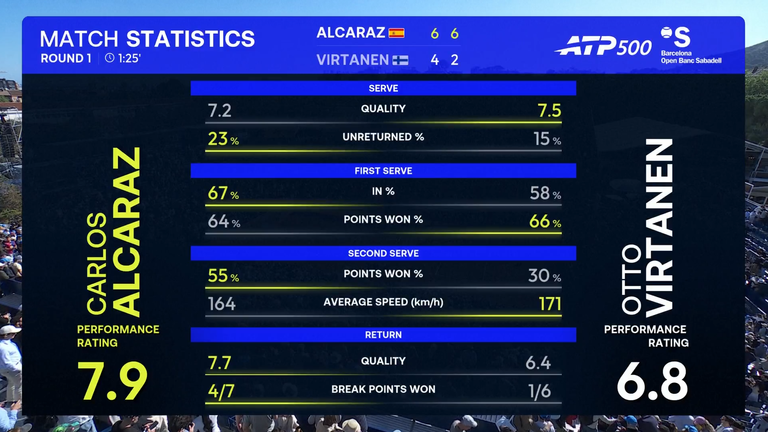
The immediate implication of his victory is his advancement to the third round, where he is scheduled to face Czech player Tomas Machac. Machac, while perhaps not as high-profile as some of Alcaraz’s usual adversaries, is a capable player who will undoubtedly pose a challenge. Alcaraz’s ability to maintain his form against Machac will be a key indicator of his readiness for the later stages of the tournament.
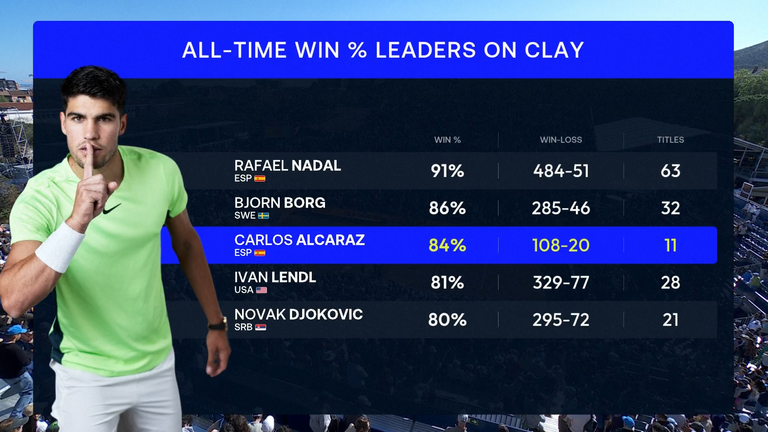
Furthermore, the statistical data presented paints a compelling picture of Alcaraz’s dominance on clay. His win-loss record on the surface is exceptional, and his success rate in Barcelona is particularly noteworthy. These figures serve as a constant reminder of his potential and the expectations placed upon him. The fact that he is chasing the world number one ranking adds another layer of intensity to his performances. Every match he wins, and every point he accumulates, brings him closer to his objective, but also increases the pressure to maintain his flawless execution. The coming rounds in Barcelona will be a critical test of his physical and mental endurance as he navigates the demanding clay-court season.
The Broader Implications of the Alcaraz-Sinner Rivalry
The burgeoning rivalry between Carlos Alcaraz and Jannik Sinner is a significant development for the sport of tennis. Their contrasting styles, youthful energy, and fierce competitiveness have captured the imagination of fans worldwide. The battle for the world number one ranking between these two prodigious talents is reminiscent of iconic rivalries of the past, such as Federer-Nadal and Djokovic-Nadal.
Sinner’s current dominance, marked by his recent string of victories, has undoubtedly fueled Alcaraz’s determination. The prospect of reclaiming the top spot by winning the Barcelona Open adds a compelling narrative to his campaign. The absence of Sinner in Barcelona, while a strategic advantage for Alcaraz, also means that the race for number one will continue to be closely watched in subsequent tournaments. The health and performance of both players will be key factors in shaping the remainder of the season.
The ATP Tour, in general, benefits immensely from such compelling rivalries. They generate increased interest, attract larger audiences, and inspire a new generation of players. Alcaraz and Sinner represent the future of men’s tennis, and their ongoing duels promise to deliver memorable moments and redefine the sport’s landscape for years to come. The journey to the top is rarely straightforward, and Alcaraz’s current challenge, marked by both physical resilience and the intense pressure of a ranking battle, exemplifies the demanding yet exhilarating nature of professional tennis.
Related posts: