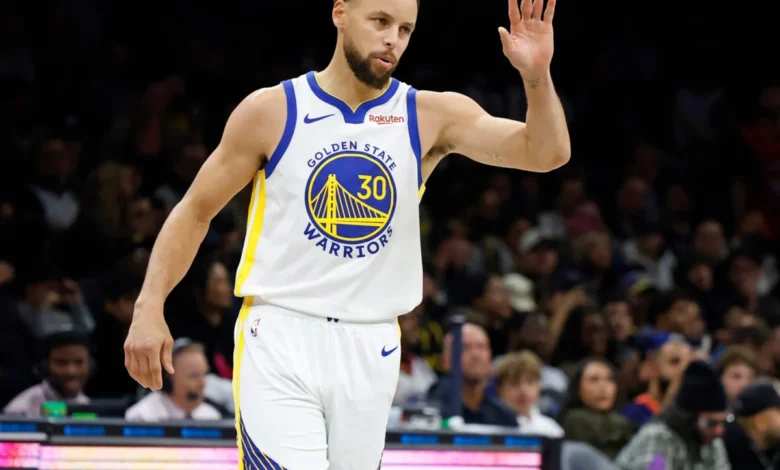
Entering his milestone 18th season in the National Basketball Association, Golden State Warriors icon Stephen Curry has spent nearly two decades dismantling the most sophisticated defensive schemes in basketball history. Throughout a career defined by unprecedented three-point shooting, multiple championships, and two Most Valuable Player awards, Curry has drawn the attention of every elite perimeter defender the league has produced.
During a recent, wide-ranging interview with ABC7 News Bay Area, the 38-year-old future Hall of Famer addressed a question that basketball analysts and fans have debated for years: Who is the toughest defender he has ever faced? Rather than naming a single opponent, Curry offered a definitive tie, pointing to two renowned perimeter stoppers who made life exceptionally difficult for him on the hardwood.
"It’s a tie for me between Avery Bradley and Jrue Holiday. Yeah, those are the guys," Curry revealed during the broadcast segment.
The selection of Bradley and Holiday sheds light on the specific type of defensive pressure that troubles arguably the greatest offensive weapon of the modern era. While Curry has routinely solved traps, double-teams, and switching defenses from entire franchises, individual brilliance from these two guards stands out as the ultimate test of his career.

Decoding the Elite Duo: Avery Bradley and Jrue Holiday
To understand why Curry singled out Avery Bradley and Jrue Holiday, one must examine the defensive ethos both players brought to the floor. Neither player relied solely on size or athleticism; instead, they combined relentless physical pressure, exceptional lateral quickness, high basketball IQ, and an uncanny ability to navigate screens.
Avery Bradley, standing at 6-foot-3, carved out a reputation as one of the most suffocating on-ball defenders of his generation during his tenure with the Boston Celtics. Bradley’s defensive prowess earned him a selection to the NBA All-Defensive First Team for the 2015-16 season, followed by a Second Team nod in 2012-13. His technique involved constant body contact, relentless ball-denial, and active hands that disrupted offensive players before they could even initiate a play. Bradley did not just guard his opponent; he sought to exhaust them mentally and physically over the course of 48 minutes.
Jrue Holiday, meanwhile, has long been regarded by his peers as the premier guard defender in the NBA. Over his distinguished career—which includes stints with the Philadelphia 76ers, New Orleans Pelicans, Milwaukee Bucks, and Portland Trail Blazers—Holiday has accumulated six selections to the NBA All-Defensive Team. Though he has never captured the elusive Defensive Player of the Year award, he has consistently been a finalist, widely respected for his strength, positional versatility, and defensive leadership. Holiday possesses unusual physical strength for a point guard, allowing him to absorb contact from larger players while maintaining the agility to stick with explosive guards like Curry through complex screening actions.
Head-to-Head Matchups and Statistical Reality
While both defenders earned Curry’s ultimate respect, the statistical reality of their head-to-head encounters reveals a fascinating narrative. Even against the toughest defensive specialists the league has to offer, Curry’s extraordinary offensive production largely persevered, though the efficiency and ease of his scoring were undeniably tested.
In direct matchups against Avery Bradley throughout their careers, Curry averaged 26.2 points, 5.8 assists, and 5.4 rebounds per game. These figures align closely with Curry’s career norms, demonstrating that the Warriors guard could still find ways to impact the scoreboard. However, box scores often fail to capture the exhaustion factor. Bradley’s persistent ball-pressure forced Curry to expend significantly more energy just to cross half-court or receive an inbound pass, altering the flow of the Warriors’ motion offense.

Similarly, in head-to-head games against Jrue Holiday, Curry averaged 25.2 points, 6.8 assists, and 4.4 rebounds per contest. Holiday’s length and physical fortitude made it exceptionally difficult for Curry to secure clean looks from beyond the arc off the dribble. Holiday’s ability to fight through Golden State’s signature off-ball screens—set by rugged big men like Andrew Bogut, Draymond Green, and Kevon Looney—forced Curry into taking tougher, highly contested shots or distributing the ball to teammates.
Despite the challenges posed by both players, neither Bradley nor Holiday was ever able to completely neutralize Curry. The four-time NBA champion’s comments reflect a mutual appreciation between elite competitors: acknowledging the immense difficulty of the challenge while affirming his own ability to rise to the occasion.
The Evolution of Perimeter Defense Against Curry
Curry’s emergence as a global superstar fundamentally changed how NBA defenses operate. Prior to his rise, perimeter defense was largely reactionary, focusing on containing penetration and contesting standard jump shots. Curry’s unprecedented range, which forced defenses to pick him up as soon as he crossed the mid-court logo, necessitated the invention of aggressive defensive strategies, including extended traps, blitzes, and relentless switching.
Throughout his career, teams routinely deployed specialized stoppers specifically assigned to shadow Curry for the entirety of a game. During the height of the Golden State Warriors and Cleveland Cavaliers rivalry, players like Matthew Dellavedova and Iman Shumpert were tasked with physical, high-energy defensive assignments against Curry. Later, defenders like Marcus Smart and Toronto Raptors wing players during the 2019 NBA Finals brought unique physical dimensions to the challenge.
Yet, it is Bradley and Holiday who permanently secured a place in Curry’s memory. Their defensive philosophies relied less on complex team schemes and more on an uncompromising, one-on-one competitive pride. Both guards embraced the thankless task of guarding the most difficult assignment in basketball without retreating or taking plays off.

Implications for Curry’s Legacy and the Next Generation
As Curry embarks on his 18th NBA season, reflections on his career inevitably highlight the milestones, championships, and records that cement his status as one of the game’s immortals. However, insights into his toughest opponents humanize the superstar, offering a rare window into the internal chess match that occurs between elite athletes on the court.
For basketball analysts, Curry’s selection validates the impact of specialized perimeter defenders in an era dominated by offensive innovation and high-volume three-point shooting. In a league increasingly driven by offensive metrics, spacing, and scoring records, the craft of lockdown defense often goes underappreciated by casual fans. By elevating Bradley and Holiday, Curry reminds the basketball world that defense remains the bedrock of championship contention.
Furthermore, these comments serve as a valuable reference point for younger generations of players and coaches. They illustrate that stopping elite scorers like Curry requires more than tactical planning; it demands elite physical conditioning, supreme mental resilience, and an unwavering commitment to fundamental defensive principles.
As the 2026-27 NBA season unfolds, Stephen Curry continues to add chapters to a storied career that has already redefined the sport. While new waves of athletic guards enter the league hoping to solve the riddle of guarding the greatest shooter in history, the benchmark set by Avery Bradley and Jrue Holiday remains the gold standard of perimeter defense in the modern NBA era.
Related posts: